


What We Lost in College Sports

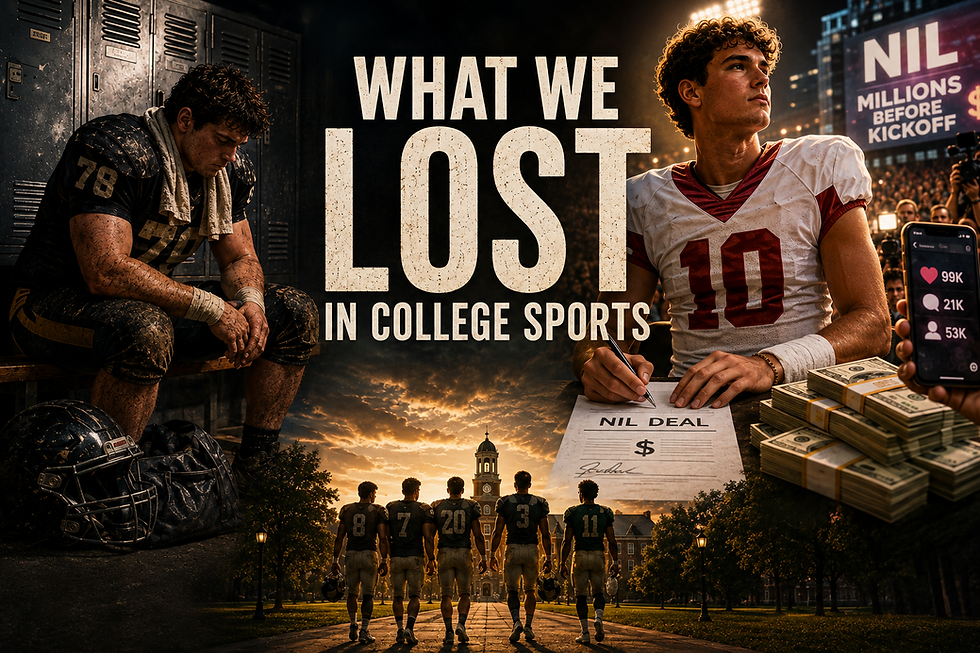
An eighteen-year-old quarterback signs a seven-figure NIL deal before throwing his first college pass. Two lockers away sits the offensive tackle who will spend every Saturday protecting him. Without that tackle, the quarterback may never complete a season. Yet one is a millionaire before proving himself. The other may receive little more than a scholarship.
NIL allows college – and in many states, even high school – athletes to profit from their name, image, and likeness through endorsements, sponsorships, appearances, and other business opportunities. Since 2021, those opportunities have transformed the landscape of college athletics.
What does this all mean? It means that the most popular and talented – though in most cases unproven – athletes can make millions of dollars per year. Many before they've ever proven themselves on the field.
So, what is the problem?
Social media influencers in their teens and early twenties make millions per year too. It is a free, supposedly capitalistic society. Everyone should earn their fair share, and they are making millions upon millions for the universities. I am okay with that, with one caveat.
This is not college sports anymore – it is the minor leagues for professional sports.
College athletes increasingly resemble professional employees, even if the legal landscape is still evolving.
The money isn't distributed fairly, either. Neither is the pressure. Expectations now fall on eighteen-year-olds performing before crowds of more than 100,000 people while simultaneously navigating endorsements, contracts, and public scrutiny.
Listen, I get it. Get what you can. I would too. Times are changing. I am all for progress, but can we do it in a sane and more meaningful way?
I don't pretend to have all the answers, but here's where I'd begin. First, pay all the players a base salary to support them as though they had a regular job in college as most regular students do. Sports in college is a job these days – long hours, the commitment and sacrifice it takes is commendable. Second, based on the sport and its revenue and profitability, pay the players that earn the university the most profits by rewarding them for their performance and commitment to the school – both on and off the field.
For example, a player at the high-profile position of QB that possesses the ability to do great things on the football field and lead his team to victories is paid a bonus based on those abilities. The longer a player stays at a university, and if they graduate, they will receive a bonus. Let’s encourage them to be better players, support their communities and get an education in the process.
There was much more the NCAA could have done to make college sports, particularly football and basketball, a better place. Now, it is a professional marketplace without a fair system.
Some of these athletes aren't even old enough to vote. Yet they're expected to navigate contracts, agents, transfer portal, endorsements, fan expectations, and social media – all of this before performing on the field.
The college sports of yesterday are no more. Television changed everything. Conferences have been realigned, universities have become more powerful and traditions have faded. Change is inevitable but not the problem. The problem is forgetting what made college sports different – athletes representing their school and growing together as friends and becoming part of something larger than themselves.
We may never fully return to that ideal. But as college athletics moves into the future, we should at least work to protect what made it worth watching in the first place: pride in a school, commitment to teammates, and the chance for young athletes to grow into something bigger than themselves.
I still love college football. I'll still spend Saturdays cheering for LSU. But loving something also means being willing to question where it's headed.
I grew up believing college sports stood for something more. Saturdays were not just about winning; they were about classmates becoming teammates, rivalries passed down through generations, and young athletes growing into leaders. Maybe that belief was naïve. Or maybe college sports have lost something worth protecting.
Because if college sports become nothing more than another professional league, we won't just lose amateurism – we'll lose something worth cheering for.


Comments