


Silence Is Also a Choice

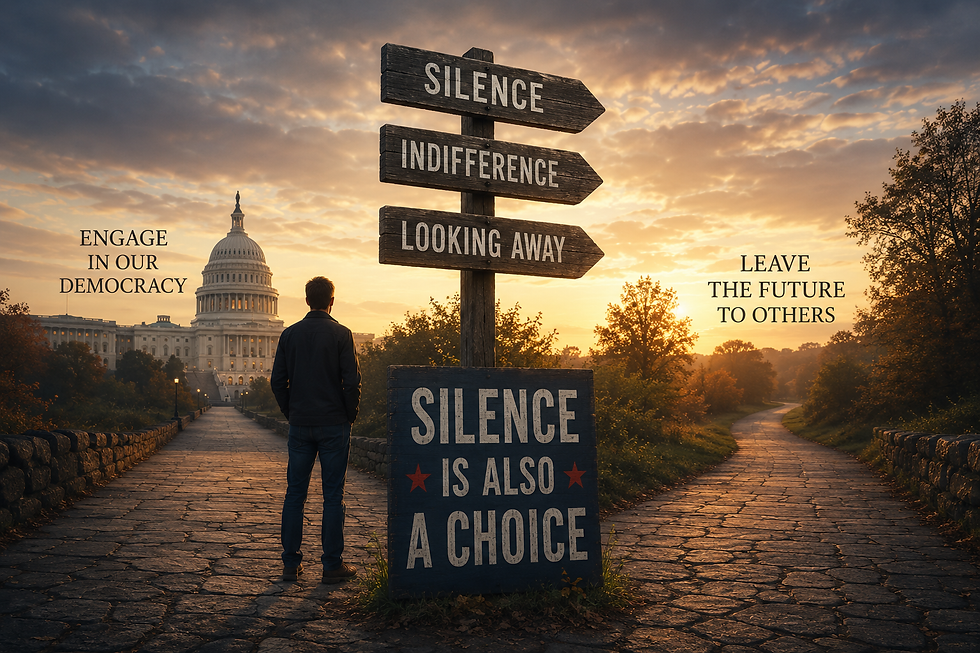
I understand why many people would rather avoid politics right now. The arguments are exhausting, the labels feel limiting, and it can seem easier to step away from the noise. I have felt that temptation myself.
But politics is about far more than campaigns, personalities, or political parties. It shapes the government that writes our laws, protects our rights, funds our schools, determines our healthcare, and influences nearly every aspect of public life. Choosing not to engage is still a choice—one that carries consequences for all of us.
Over the years, my own views have generally aligned more closely with liberal principles. Even so, I have never believed that one political party has a monopoly on wisdom or public virtue. Conservative thought has contributed important ideas about personal responsibility, fiscal restraint, strong communities, and civic duty. Healthy democracies benefit from thoughtful disagreement and principled debate.
What concerns me today is not that Americans disagree. Disagreement has always been part of our national story. What concerns me is the growing willingness to abandon democratic norms, dismiss objective facts, and elevate loyalty to individuals above loyalty to constitutional principles.
The United States—and, by extension, much of the democratic world—feels as though it is standing at one of the most consequential moments of my lifetime. For decades, our two-party system functioned because both parties generally accepted certain foundational commitments: respect for elections, the peaceful transfer of power, an independent judiciary, and the idea that no one is above the law. Whether those commitments remain secure is, in my view, one of the defining questions of our time.
For me, this is no longer primarily a debate about liberal versus conservative. It is about integrity, empathy, compassion, honesty, and the willingness to defend democratic institutions even when doing so is politically costly. I struggle to reconcile those values with continued support for Donald Trump, and I recognize that reasonable people will disagree with that conclusion.
For readers who are trying to understand this moment—whether they agree with me or not—these are three writers whose work I return to regularly because they encourage careful thinking rather than slogans.
Heather Cox Richardson — Letters from an American
Richardson places current events within the broader sweep of American history, helping readers understand today's challenges through the lens of our democratic traditions.
Jim Wright — Stonekettle Station
Wright combines military experience, humor, and direct political commentary to challenge conventional narratives and encourage civic responsibility.
John Pavlovitz — Stuff That Needs to Be Said
Pavlovitz approaches politics through the lens of faith, compassion, inclusion, and moral accountability, asking readers to consider what their values require of them.
Their writing does not tell me what to think as much as it encourages me to think more carefully. In a time when outrage is abundant and certainty is cheap, I find that increasingly valuable.
Responsibility, compassion, and democratic citizenship still matter. They always have. The question each of us must answer is whether we are willing to defend those values when doing so becomes uncomfortable.


Comments